It’s college application season, and, for most seniors, that means increased stress and worry about their futures.
An integral part of the college application process is the personal statement—a 250-650-word essay required by most colleges and universities through The Common Application (Common App). This leads to an annual and universal craze among students to write the best possible one.
The Common App provides applicants with six prompts to choose from, along with a seventh option to write about any topic of their choice. This means they can use their own prompt or write a statement from a prompt from another college essay or scholarship.
First, let’s identify why the personal statement is so important. Aside from the other supplemental essays, it is the only opportunity for applicants to convey their personalities. Colleges see GPA, test scores and class rank, but their only way to truly get to know a student is through their writing. Its word count inherently allows for a more creative form of writing, as this style is often the most direct way for students to accomplish said goal.
This level of importance directly justifies students’ worries and desires to do well on such an essay. English teacher Kanoa Mulling delved into this mental phenomenon among students. Despite the desire to be uber-creative and tell a compelling story, Mulling stresses that, in students’ minds, although it is expressive writing, it isn’t just for fun.
“[Students often believe the personal statement] is [what’s] gonna get [them] into college or not. And so [they] don’t just fully abandon into bearing [their souls], it’s like, “What’s going to be impressive [to colleges]?” Mulling explained.
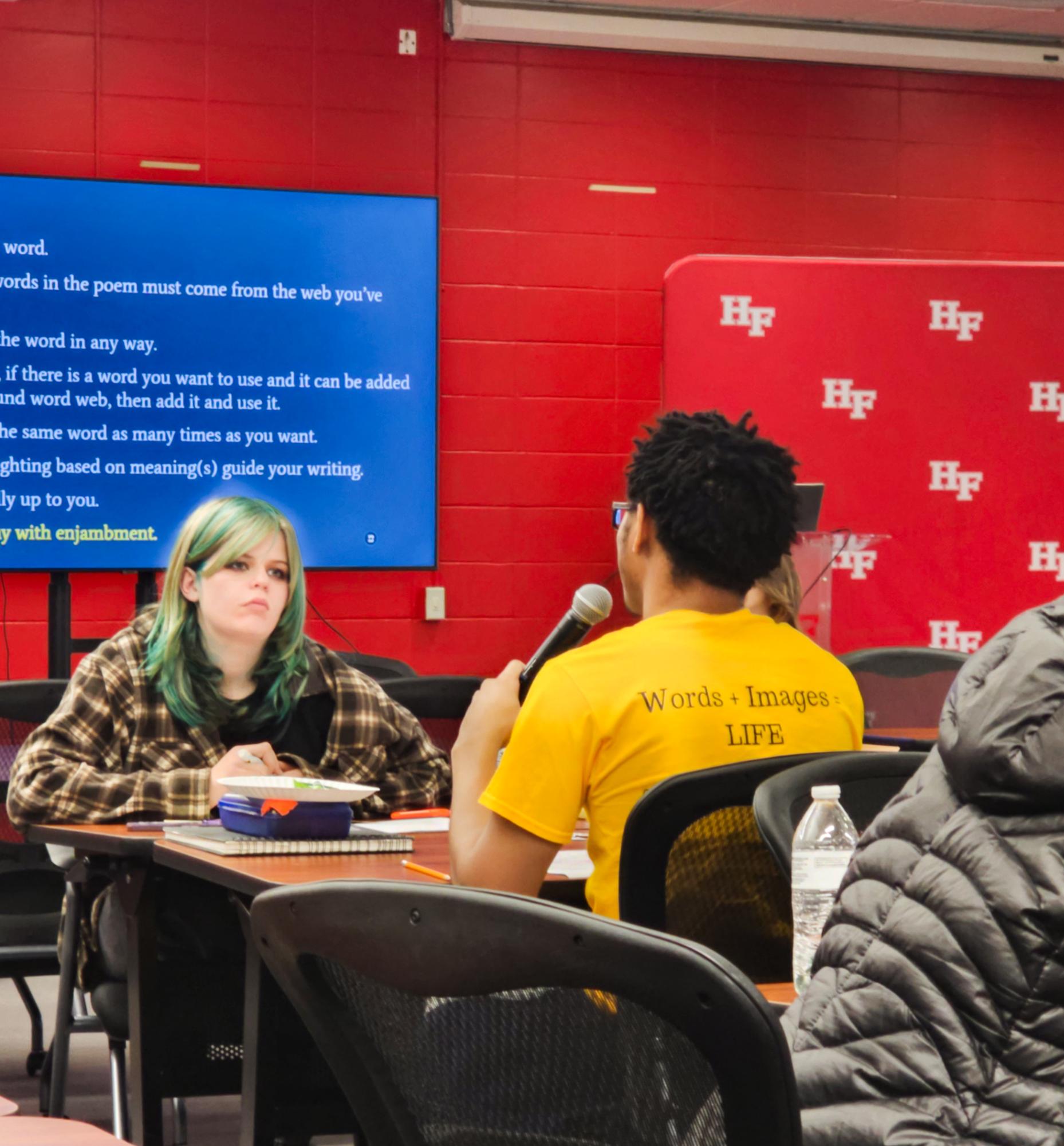
This strenuous stalemate between students and the paper can only be eliminated through students’ increased exposure to creative writing in their classes. Given the universal sense of tension around the personal statement, schools should offer more creative writing opportunities for students. However, at H-F, only two creative writing classes are offered: Creative Writing 1 and Creative Writing 2, an improvement from having both classes merged in previous years. Most students would likely say that they don’t practice creative writing in their core English classes.
As a result, students often lack skills in storytelling and creative writing, but are proficient or excel in argumentative and analytical writing. Thus, students are missing out on crucial creative writing skills that will improve their personal statement and overall writing. English and creative writing teacher Sahar Mustafah discussed how creative writing develops vital skills and embeds them in its coursework.
“Thinking creatively is really exercising the brain and stretching the imagination. It’s also an exercise in language choices. So, students have to make very particular choices about the language that they’re going to use [to] express a particular idea [to] build a setting, [to] vividly depict a character,” Mustafah stated.
Elaborating on these circumstances, Mulling considered the lack of exposure to creative writing in many students’ core English classes. “But [for] the college essay, when have you written a narrative? When have you written a narrative about yourself? When has [writing about yourself] been valued? When so many of the academic rules try to say, no first person, you are literally erasing yourself from the equation,” Mulling reflected.
Mulling claimed that creative writing is already integrated into classes but simply needs an enrichment opportunity. Instead of treating students’ writing superficially by having them merely check off boxes, Mulling believed that teachers should adopt a different approach in class discussions to enhance students’ creativity.
“Right when that debate is at its clearest, maybe that’s the best way to get the insight that we want. Because I think so often students are really asking while they’re writing an essay, “What am I supposed to be writing here?” instead of “What do I think? What do I want to argue?”
And it takes a level of confidence and a sense of freedom to be able to say, “Oh, I can succeed by writing what I think,” Mulling observed.
To transform that mindset, Mulling stated that students have to write more for themselves rather than for their teachers. Mustafah elaborated on this idea, saying that “creative writing offers students a space to break from traditional modes of writing. I think our students are really skilled at analytical, argumentative, [writing and] the traditional literary analysis, but they don’t always get opportunities to write in this creative mode.”
The absence of these intentions from students’ mindsets in their classes is directly responsible for their lack of personality in their writing.
Coming out of desires and back to reality, what can seniors applying for regular decision deadlines and juniors preparing to apply to college next school year do to have a pleasant writing experience with what they have at their disposal? Mulling advice for students is simple: “Start early and take risks.”
He addressed how students often stare at that blank screen for hours, not only because of their lack of experience in creative writing, but also because they misframe the purpose of writing as “the product of our thinking, not the vehicle of it.”
However, Mulling emphasized that the beauty of writing is in the struggle, declaring, “The process of writing, the problem-solving that it takes to go from sentence one to two to three to make a point, that hour you spend can be the way you discover your idea, you don’t have to have the idea. You gotta have a hunch. Get the hunch, follow the hunch, say, screw it, I’m taking a risk.”
So, students, take that risk and let your creativity flow. Don’t let a curriculum dictate your creativity.