
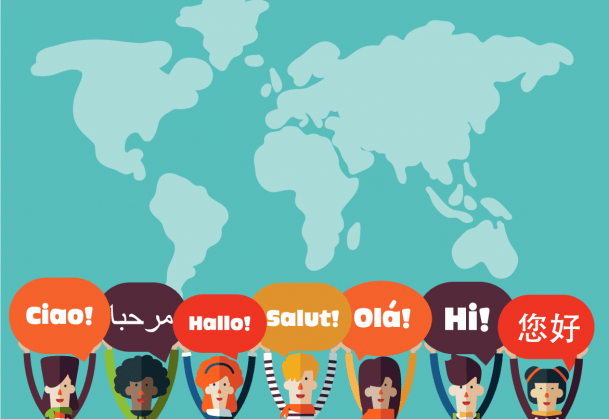
¡Hola!
Bonjour!
こんにちは!
These are some of the common languages that English speakers in the United States choose to learn at some point in their lives. I’m here to convince those who haven’t to pick them up and study them. While you don’t have to be bilingual to succeed in life, there are many benefits, whether it be professional, academic, or personal.
Before potential language learners discuss the benefits of being bilingual, they need to know what it means to really “know” a language. According to Immersio, a language learning platform, being able to converse in a foreign language means more than just knowing words off a simple vocabulary list.
They state that those who want to be fluent need to have eight different facets of knowledge of a language: lexical, morpholexical, morphological, grammatical, syntactic, idiomatic, pragmatic and discourse. While this may seem overwhelming, Immersio claims that “to become truly fluent, it’s important to learn each one of them to some degree.” This is why many people may choose for their children to learn a language early.
According to ScienceDirect, the Critical Period Hypothesis (CPH) is the belief that suggests there is a specific window of development (roughly from the first couple of years to puberty) in which an individual can acquire a second language with native fluency. Mia Nacamulli, a writer and educator for TED Talks, claims that if this hypothesis proves true, “learning a language in childhood may give you a more holistic grasp of its social and emotional contexts” than those who learn it later in life.
Regardless, learning a second language at any period of your life has incredible cognitive and social benefits. While being fluent might help, even knowing the basics of another language can significantly increase the number of people you can reach out to. This leads me to one of the main reasons why language learning is so suggested in the learning curriculum, especially in middle schools and high schools.
While it doesn’t accurately increase General Intelligence (IQ), it can lead to a better grasp of executive functions and improvement in cognitive and sensory processing. According to the National Library of Medicine (NLM), “researchers have shown bilingualism to positively influence attention and conflict management in infants as young as seven months.” The NLM further describes a study in which bilingual children responded as expected to classical conditioning and adjusting to new rules. This shows that even for young children, being bilingual comes with advantages that go beyond just knowing the language.
Even outside of cognitive benefits, knowing another language opens the door to understanding cultures different from your own. Being bilingual builds bridges between societies, fostering connection, innovation and empathy.
H-F Foreign Language teacher Rodolfo Rios, said “the importance is that it gives students a better grasp of their surroundings whether they’re meeting people at school, people they’re going to work with, and even in their neighborhoods…an understanding of how we can all be different even within the same language and the cultural understanding that comes with it.”
Learning another language isn’t just a mere tool for communication, but a way to transcribe a community’s identity, values and history. This is why, whether you spend five minutes or five hours on it, you should take the time to learn and appreciate one of the many languages that surround you.