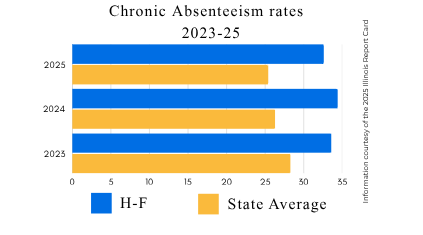
The 2025 Illinois Report Card reported a 32.6 percent chronic absenteeism rate for students at H-F. The rate dropped 1.8 percent from 2024 but remains 7.2 percent higher than the state average.
Chronic absenteeism is defined by the U.S. Department of Education as “missing at least 10 percent of school days, or approximately 18 days in a year, for any reason, excused or unexcused.”
Many variables contribute to the rise in absenteeism witnessed not only by H-F but also in schools across Illinois, as the Illinois State Board of Education (ISBE) reports that 1 in 4 public school students were chronically absent in the 2024-2025 school year.
An unignorable factor is the pandemic-driven decrease in attendance rates. “I think kids being isolated, out of school, away from their classmates, in front of a computer for hours, it caused some issues,” Associate principal Craig Fantin said. “Especially during the time in which it happened for students [who are now attending high school], Those are very formative years in your life.”
This theory is heavily supported by statistics. According to EducationWeek, “New research shows that even regular attendees are missing more days following the pandemic compared with before it.”
On Jan. 1, 2022, Illinois enacted Senate Bill 1577. According to ISBE, this act allows students up to five mental health days without a required medical note. “We aren’t denying the necessity for those, but the problem is those still count against our attendance,” Assistant Principal Jim Schmidt said. “So while the state is saying on one hand, we recognize [the students’] need for mental health days, the school is still going to get dinged for it on the other.”
Administration believes that solving the absenteeism problem means investigating why students aren’t coming to school. “This is an individual student or individual family conversation,” Schmidt said. “‘Are we supporting our students? Is this an environment where our students want to be?’ That same conversation needs to be looked at individually, dynamics are changing all the time, which means we have no idea what could be impacting one specific student.”
A current push in attendance strategy is finding an incentive, something that makes the student want to come to school. This incentive could be an extracurricular activity, an elective aligned with their interests, or a bond with a staff member. “We find that when students have a connection with an adult here or multiple adults, they’re more likely to open up to us,” Fantin said.
Students are all provided opportunities to build these relationships. “Every student has a support team, and these have existed here for the last 15 to 20 years. It’s made up of the counselor, dean and social worker,” Schmidt explained. “They’re constantly meeting weekly or biweekly and they’re looking at that student data, trying to find where to begin to work with that student and that family. “
The H-F student handbook states that students with more than eight absences from a course risk being dropped from that class. However, administrators clarify that this consequence is rarely instituted. “The biggest part of the attendance policy is the communication that’s triggered between the school and the parents, that’s what we want to stress,” Fantin said.
According to the 2025 Illinois Report Card, seniors statewide exhibit higher chronic absenteeism rates than peers at other grade levels, with H-F sitting at a rate of 40.9 percent and the state average at 41.5 percent. “Senioritis affects performance every year, but [principal Clinton Alexander] does an exceptional job keeping them on track with the social probation risk and the end of year incentives,” Director of student supports Jennifer Rudan said, “Nobody wants to miss prom.”
Attendance is more than just a number on a report. “We want students in class because that’s where the teachers are. That’s where all of the instructional time takes place,” Rudan said. “There aren’t many online learning resources at H-F that can compare to that.”
Schmidt believes that good attendance shows implications beyond the classroom and the walls of H-F, “I’ve known people who have lost their jobs due to chronic absenteeism. Right now, these consequences are minimal: you get a detention, you might get a Saturday detention at worst. When you lose a job, that’s life-changing.”