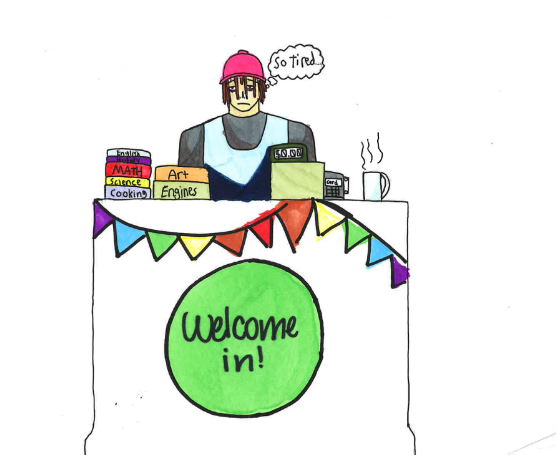
53.1 percent of teens in America ranging from the ages 16 to 24 work. It is common that teenagers around the ages of 16 to 24 who are in school have jobs. U.S. Bureau of Labor Statistics also states, “In July 2025, there were 21.1 million employed youth (people ages 16 to 24) in the United States.”
I am a part of the percentage, I am 17 and I work at Crumbl Cookie in Homewood, and my hours range from 10 to 15 hours a week, which isn’t bad, but most of my days are filled. It’s hard for me to hang out with family and friends or even just have personal time to myself.
I usually work on Wednesdays, Thursdays, Fridays and Saturdays. On Tuesdays, I have ACT prep, which is from 6:30 p.m. to 8:30 p.m.
I also have physical therapy once, sometimes twice a week and regular therapy once every other week. So, it can be inferred that I usually have a busy schedule.
Teens all around H-F who are of the age of 16 have jobs. Without jobs and money, you can’t get anything such as food, clothes or go out to do fun activities because everything nowadays costs money. But, how do jobs affect the student body?
According to Mental Health America, “One study showed that 70% of college students are stressed about finances.[1] With work, school, activities, and friends all demanding attention, many students struggle with balancing and prioritizing the different areas of their lives.”
Joy Benjamin, a sophomore at H-F who currently babysits while balancing school work and her job said, “[I work] 10 hours a week. It negatively affects my life because I am struggling to finish my school work while I am at work [watching the kids].”
Kellia Anthony, a junior, has a positive outlook, “I do athletic training, I work about 12 to 15 hours a week. Juggling athletic training and school actually has a positive impact on my mental health because I love being there and I love doing the athletic training job.”
The staff at H-F try to help the students as much as possible because they all care about their well-being. They hope to help students gain positive mental health because that could help students focus on their studies in school.
Robert Suarez, a counselor at H-F, cares deeply about the student body and about the mental health of H-F students. He is also a large mental health advocate who loves to talk about different ways students can help manage their stress between school life, work life and their personal life.
“Over the years, many students and adults have reached out regarding stress. I also reach out to my support groups, mainly my wife and great friends, to cope with stress from work, family and life. The common denominator of all stress is that people and situations are mostly out of our control,” he said.
Lisa Dallacqua, the assistant superintendent of curriculum and instruction at H-F, is a huge advocate for teens’ mental health. She opened up and shared that whenever she feels stressed or overwhelmed she will work out or go to yoga.
She continued with how she believes schools could help students with managing school work. “I think as teachers we often forget that students juggle school, work, activities, papers and projects. I tell my students if they need another week, take another week. Just let me know so I am aware and so I can know when you are okay,” she said.
Teens nowadays need something or someone to look to for guidance with their stress. H-F understands this and provides all students with their own counselors and social workers that they can talk to when they need help.