An itchy Halloween costume, that cute workout set that’s in your Amazon cart and the jacket you thrifted last week are all killing you. And I don’t mean it in a spooky, “it’s Halloween” kind of way. I mean it literally; all of these things contribute to destroying our planet.
This year, October was the second hottest October on record in the US, according to the NOAA. Complaints were heard regarding the fact that it was still over 80 degrees during the first weeks of the month. The culprit behind your sweaty pits during fall is climate change.
Climate change is the prolonged global temperature and weather pattern shifting beyond natural variability.
The World Meteorological Organization stated that the last 10 years have been the warmest on record globally, and we’re a part of the cause. The U.S. Environmental Protection Agency explained that deforestation, burning of fossil fuels and heat-trapping greenhouse gases in the atmosphere have all played a role in the decaying of our Earth.
While infrequently talked about, there are small problems within climate change that cause more damage than you’ll ever imagine.
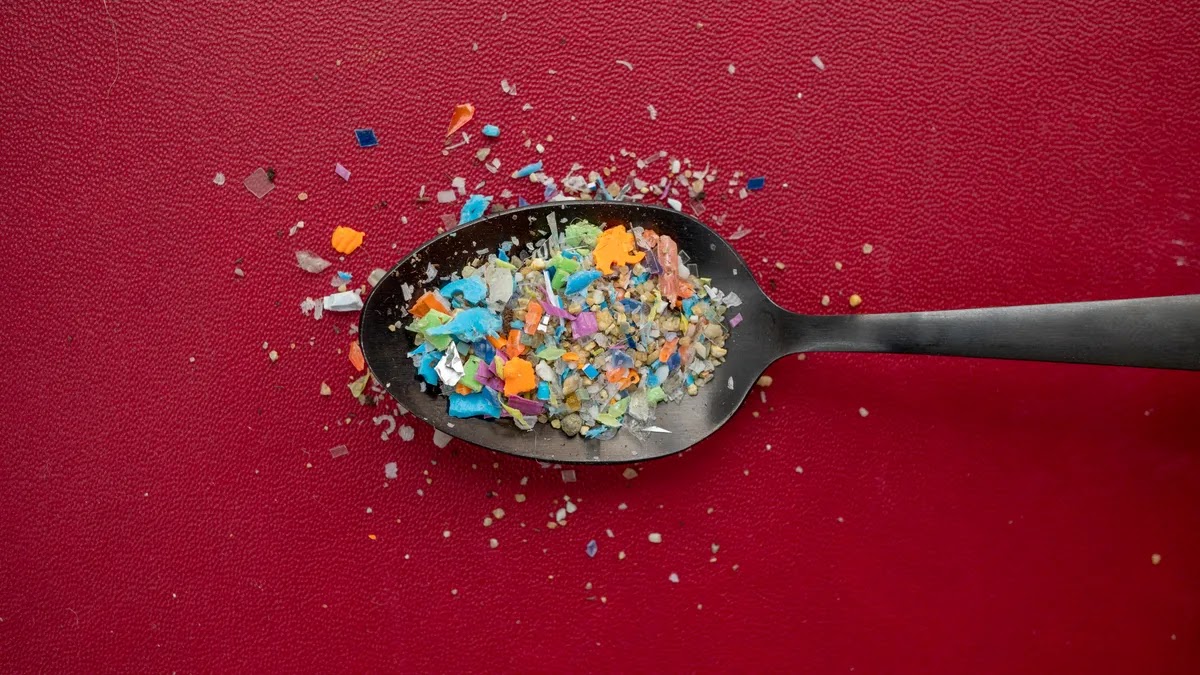
One of these misfortunes is microplastics. Microplastics are extremely small contaminants derived from fragmentation of consumer products and industrial waste in the environment, according to The Washington Post.
“Microplastics have infiltrated our daily lives, far more than many people realize. These tiny plastic particles [less than five millimeters in size] now touch nearly every aspect of human life, from the food we eat to the air we breathe,” explained Rick Pavinato, a chemistry teacher at H-F, concerning how recurrent microplastics are.
A common misconception about plastic is that it “disappears” once we burn it, throw it away or let it drown in the ocean. In reality, our plastic stays in the environment and ocean once we try to go around properly disposing of it.
The Guardian stated that human studies have found that the brains of dementia patients, the plaques from people with heart disease and within people who suffer from stroke, a heart attack or sudden death all have one common factor: microplastics.
In an article by David Wallace-Wells, he revealed that the amount of plastic in our bodies has been affecting female and male reproductive systems, which shows that it isn’t only affecting the “yet to be born,” but also the “yet to be conceived.”
When we hear about microplastics, the common reaction is very underwhelming when this growing problem isn’t just affecting us but rather the generations after us.
You’d think that since this is a significant problem which can cause permanent consequences, it’d be talked about as much as it can. However, that’s not the case as far as school curriculums go.
Environmental science teacher at H-F Stephanie Gioiosa recalled that they talked about microplastics in their water units, diving into water pollution, the circulation of trash and plastic within the oceans and occasional lessons that arise based on related articles.
For something that’s actively destroying our Earth, it is only brought up in certain classes and occasionally in the curriculum. This brings attention to where we can get our information about microplastics from.
“I feel like that’s something you would see on TikTok, like save the turtles. But no, nobody really talks about microplastics, maybe we should,” said Lady Teodora Gibson, a junior at H-F. She remarked that in her years of taking science, microplastics wasn’t a topic that her teachers explained, but rather something she learned about through social media.
There is still so much unknown as to what microplastics are doing to us or how they’re exactly affecting us in the long run. But the best thing to do is to stay informed on how to fend off microplastics.
This sentiment was emphasized by Gioiosa, who said, “A lot of the studies that are being done with microplastics say that we can’t pinpoint how microplastics are impacting people yet.”
There is a large spectrum of things containing microplastics and actions we can take to fight against the pollution of microplastics. Making small changes in your lifestyle, such as reducing the use of “single use” plastics, filtering your water and even recycling properly, can prevent microplastics from polluting your life.
Choose natural fibers, ditch the single-use containers and start thinking twice before buying that 100% synthetic costume you’ll wear once, just to never pick it up again.
Without the regulation of microplastics, it’s up to the choices and actions of our own to prevent this problem from implanting itself in our future world beyond repair.
The fight against microplastics reveals a sobering truth. This man-made crisis is now a fundamental part of the natural world it has poisoned.