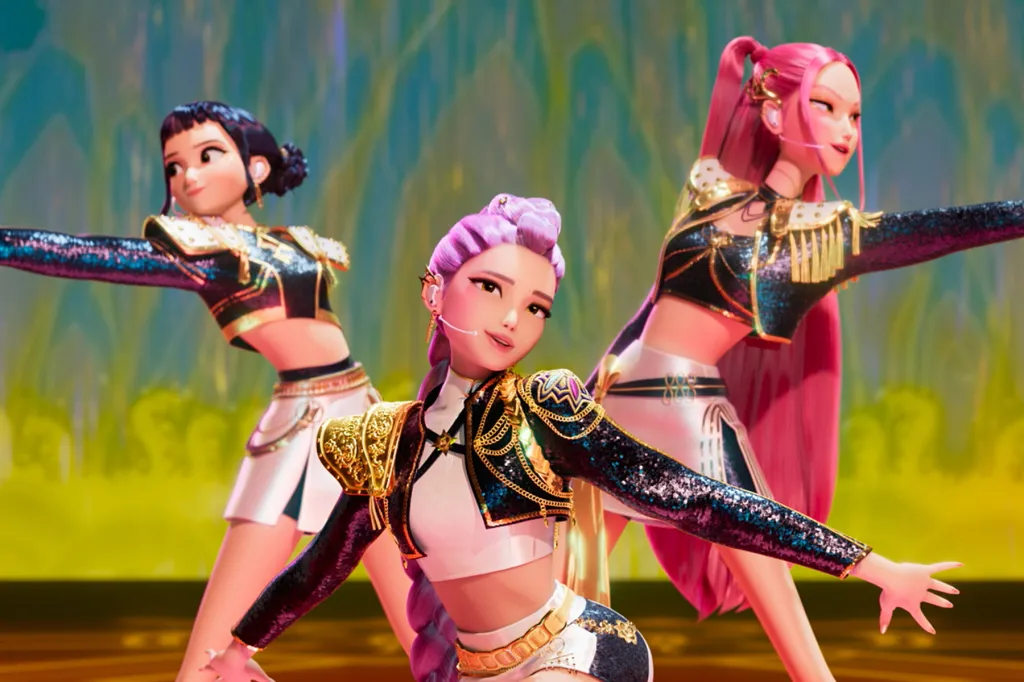
K-Pop Demon Hunters, the music-filled blockbuster released on June 20 on the streaming platform Netflix, has absolutely taken the internet by storm. The animated movie follows fictional superstar K-pop girl group HUNTR/X. When they aren’t recording their next hit single, they fight demons with their voices, along with modified blades based on traditional Korean weaponry.
Their goal of protecting the honmoon, or “soul gate” in Korean, and their fans from the clutches of demons seem manageable at first. However their demonic counterpart, the Saja Boys, show up as a rival boy group and make their jobs a lot harder.
While many might see this as just one of the most popular kids movies of the decade, its success is a cultural milestone for K-pop, as it’s transforming from a niche interest to a vital part of the Western mainstream musical industry.
In the late 2000s and early 2010s, various K-pop companies dipped their toes into the American market, gaining much success and recognition with songs such as “Bang Bang Bang” and “Fantastic Baby” by Big Bang and PSY’s “Gangnam Style”. However, no band has ever blown up as much as global sensation BTS with hits such as “DNA,” “Fake Love,” and “Boy with Luv (ft. Halsey)”.
Recently, while there is no concrete number of Kpop fans, in 2024, Park Hyeri, a reporter for the Republic of Korea’s newsletter, claims “The number of Hallyu fans worldwide in December last year hit 225 million, a 24-fold jump from 9.26 million cited by the inaugural survey in 2012 and up 46 million (25.8%) from that in 2022.” The reach of Kpop as a genre has reached millions; Personally, I have been listening to Kpop for almost a decade.
K-Pop Demon Hunters director Maggie Kang stated in an interview with Geeks Out that she has “always wanted to see an animated film set in Korean culture”.
From stage outfits to lightsticks, this is evidently clear in how much the movie is integrated into real K-pop industry culture. It is also a big step into more East Asian representation for main leads in major picture productions.
In 2023, Gold House released a study about Asian representation in streaming which revealed that among the top 100 titles on streaming platforms in 2022. Out of the total 347 identified Asian characters, only “99 (28.5%) were categorized as major characters, consisting of 20 leading characters (5.8%) and 79 supporting characters (22.8%)”. Moreover, only 11 were explicitly East Asian.
From Tik-Tok trends to scoring number one on Billboard’s Top 100 with their song “Golden,” many people are hesitant to give the movie its flowers because they see it as “immature,” “cliche,” or “cringe.”
But even so, the fact that K-Pop Demon Hunters comes from Sony Pictures Animation, a major western production company, shows how the entertainment industry sees K-pop as marketable to general audiences, not just fans.
By blending K-pop’s music, aesthetics, and performances with familiar movie genres such as action and animation, the film makes K-pop accessible to those who aren’t familiar with it while still acknowledging its global influence. K-Pop Demon Hunters shows that the genre isn’t just a passing trend or something to be ashamed of but something that can be a huge influence in the Western mainstream.