Chicago’s best kept secret is not hidden within the government’s infrastructure. It is not buried deep within files stamped with bold red letters, splattered with the word ‘confidential’ across the top.
It is in plain sight, overshadowed by skyscrapers, drowned out by traffic and ignored by a city that walks over its history every day.
It is a simple fact that has been kept quiet for far too long: the cobblestone on which Chicago was built was laid by the hands of a Haitian man.
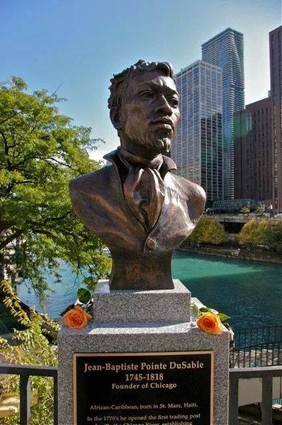
His name is Jean Baptiste DuSable, the founder of Chicago, and the man known as the “Father of Chicago.”
For a city that prides itself on its history, his name is not readily recognized. It is not taught in local schools, and the city he founded in 1780 has only recently made strides in recognizing his contributions.
This was not accidental. As Lerone Bennett Jr., a renowned African American historian and journalist, once said, “For 10 years, at least, I’ve been fighting in Chicago to get the public school system, to get the media, to deal with the biggest secret in the history of Chicago. At this moment, the biggest secret in Chicago is that Chicago was founded by a Black man.”
For generations, the truth has been ignored, minimized and overlooked. But history does not wait for convenience; it lies under the surface, waiting to be discovered.
We have seen this pattern before, from the Tulsa Race Massacre to Juneteenth itself. These stories were never lost; they were simply ignored.
This is the recipe. Lauren Robbins, a licensed professional counselor, explained that the only way to move past a secret is to “stop pretending and break the silence” and “let someone help you carry the burden until it’s no longer there.”
As a city, we must carry this burden together, not hide it as a mystery or problem, but make it public knowledge that we are proud to share.
The first step is to break the silence, and the only way to do that is to know what to talk about.
DuSable was an educated man, born in 1745 to an enslaved African mother and a French father.
At that time, education was an infrequent opportunity for Black people. As Colonial Williamsburg notes, “Whether free or enslaved, however, Black children had almost no access to education.”
DuSable did more than have access to education; he accessed it around the world.
“DuSable traveled with his father to France, where he received some education,” wrote Wilson Edward Reed, a criminal justice consultant for the Washington Department of Social and Health Services. “Through this education and the work that he performed for his father on his ships, he learned languages including French, Spanish, English and many Indian dialects.”
He later traveled through New Orleans and Mississippi before settling on land along the Chicago River, land other settlers overlooked.
“DuSable built the first permanent home of Chicago from scratch with nothing but hope and faith,” said Margaret Burroughs, a founder of the DuSable Museum of African American History.
In her essay about the wild frontier DuSable inhabited, she wrote, “DuSable, a gentleman of African ancestry, stayed. He recognized it as a strategic location. He was the first man, black, red or white man, to see the commercial possibility of the place.”
Not only did DuSable build the city’s first permanent home, but he also “claimed about 800 acres of land and established a thriving trading post,” Reed wrote. ”[The post] included a mill, smokehouse, workshop, barn and… became a major supply station for other traders in the Great Lakes region.”
DuSable laid the foundation and blueprint for the thriving Chicago we know today.
Progress has been made in recognizing his legacy. As reported by Fox News, Lake Shore Drive was officially named Jean Baptiste DuSable Lake Shore Drive in 2021 to honor his contributions to this city.
There is still more work to be done. Take back your power. Learn and educate yourself on the very land you walk on. Visit the DuSable museum or the DuSable monument.
Search for what others fail to acknowledge. Expose Chicago’s best-kept secret and turn it into Chicago’s loudest boast.
Chicago was founded by a Haitian man. And we walk in his footsteps each day.