Ette. This suffix is one applied to a variety of nouns, with words like majorette, cigarette or kitchenette. It often signals smallness, a reduced version of the original. When added to women’s titles, it has historically suggested not just smallness, but secondary status.
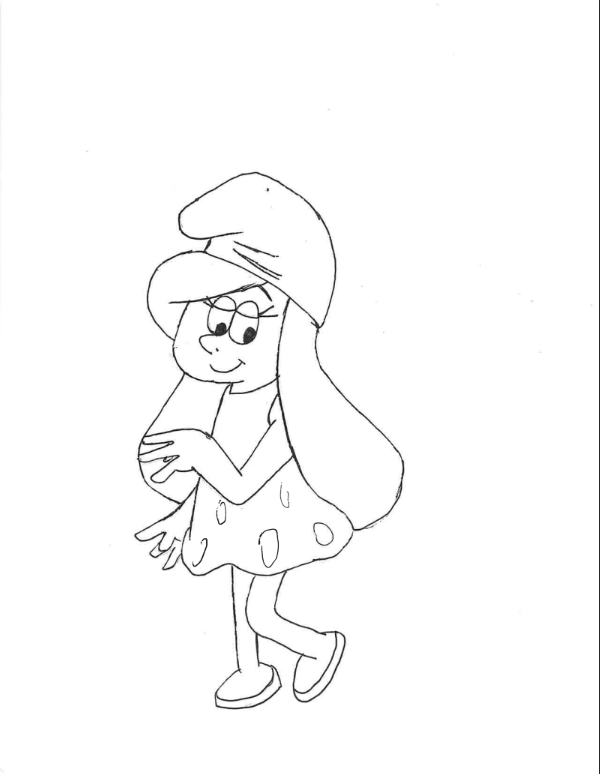
The word I will be focusing on today is Smurfette.
In the movie “The Smurfs,” Smurfette is the only female in the village of male Smurfs. In the 2011 film, one Smurf jokes, “Smurfette is part smurf and part ‘ette.’ All we have to do is figure out what ‘ette’ means.
The line was said for humor but in it, it reveals something deeper: Smurfette is not defined by who she is but by how she differs.
In “The Smurfs,” everyone has a personality and characteristic that defines them: Grumpy Smurf, Smarty Smurf, Hefty Smurf and even Clumsy Smurf. You immediately understand who they are and how they contribute to the village.
Smurfette’s name, however, does none of these things and offers no attribution to her skill, personality or talent but simply to her gender.
Her name lets you know, almost with a parade of balloons and party blowers, that she is “the girl.”
This is a reflection of what is called the Smurfette Principle. This is a principle coined by Katha Politt, an American feminist writer, who in a 1991 essay for The New York Times wrote, “Boys are the norm, girls the variation; boys are central, girls peripheral; boys are individuals, girls types. Boys define the group, its story and its code of values. Girls exist only in relation to boys.”
In other words, men are treated as the default and women as the exception.
We see this in Smurfette’s characterization, as she is given little identity beyond stereotypical traits. She is blonde, obsessed with clothes, shopping and unicorns.
While the male Smurfs are defined by skills and roles, she is defined by her femininity. Her presence is symbolic before it is substantial.
She has more stereotypically feminine lines, such as “I can have more than one kind of dress? What?” and “I get so puffy when I travel,” which gives no depth to her character or personality.
Throughout the films, we have seen Smurfette navigating her identity, even trying on the personalities of other Smurfs to see where she fits.
While simultaneously navigating the affections of the surrounding Smurfs, Smurfette mirrors how women are often seen as objects of desire, as someone there to be infatuated with, rather than someone there because they are capable and qualified.
Women in these male-dominated spaces oftentimes have to deal with stereotyping, bias based on gender and a strong need to repeatedly prove competence. They are expected to represent all women while also proving they belong in the space at all.
All of these traits are shown through Smurfette.
We have all been a Smurfette, we have all been in spaces where we felt we had to dim our shine, always be the “cheerful girl” or even assume the personalities of those around us to try to fit in.
We have searched for our belongings in buildings built without women in the blueprint.
Systematically, women still find themselves in positions where others question whether they are equitable, even when they are.
Smurfette’s journey evolves as she begins to move beyond the title of just “the girl.” As we near the end of “Smurfs: The Lost Village,” we learn, “Smurfette can’t be defined by just one word. She’s many things.”
No one is just an “-ette.” Smurfette can be anything she wants to be, and you can too.
The moment we stop treating women as variations and start recognizing them as central to the story, we can begin to move beyond the suffix altogether.