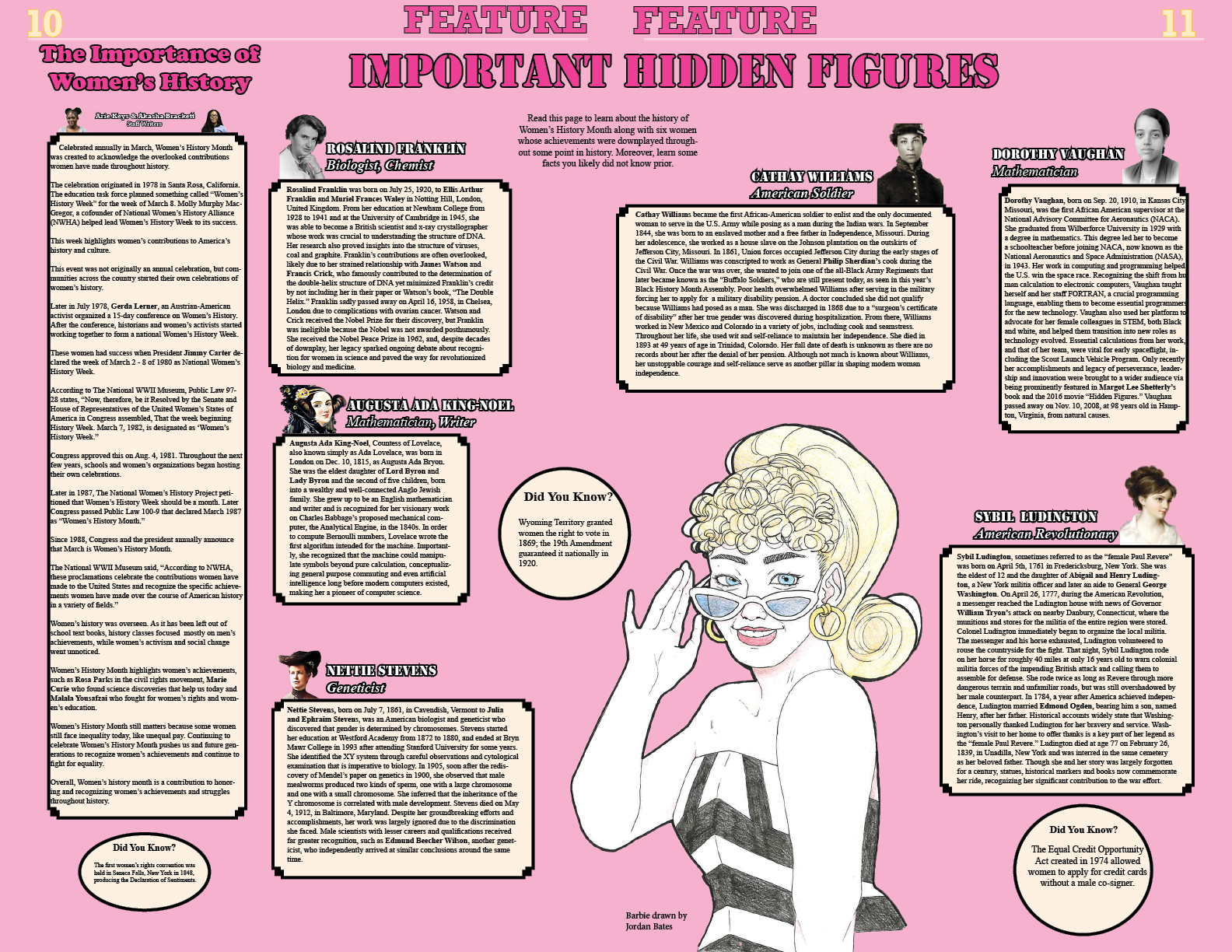
Rosalind Franklin was born on July 25, 1920, to Ellis Arthur Franklin and Muriel Frances Waley in Notting Hill, London, United Kingdom. From her education at Newham College from 1928 to 1941 and at the University of Cambridge in 1945, she was able to become a British scientist and x-ray crystallographer whose work was crucial to understanding the structure of DNA. Her research also proved insights into the structure of viruses, coal and graphite. Franklin’s contributions are often overlooked, likely due to her strained relationship with James Watson and Francis Crick, who famously contributed to the determination of the double-helix structure of DNA yet minimized Franklin’s credit by not including her in their paper or Watson’s book, “The Double Helix.” Franklin sadly passed away on April 16, 1958, in Chelsea, London due to complications with ovarian cancer. Watson and Crick received the Nobel Prize for their discovery, but Franklin was ineligible because the Nobel was not awarded posthumously. She received the Nobel Peace Prize in 1962, and, despite decades of downplay, her legacy sparked ongoing debate about recognition for women in science and paved the way for revolutionized biology and medicine.
Augusta Ada King-Noel, Countess of Lovelace, also known simply as Ada Lovelace, was born in London on Dec. 10, 1815, as Augusta Ada Bryon. She was the eldest daughter of Lord Byron and Lady Byron and the second of five children, born into a wealthy and well-connected Anglo Jewish family. She grew up to be an English mathematician and writer and is recognized for her visionary work on Charles Babbage’s proposed mechanical computer, the Analytical Engine, in the 1840s. In order to compute Bernoulli numbers, Lovelace wrote the first algorithm intended for the machine. Importantly, she recognized that the machine could manipulate symbols beyond pure calculation, conceptualizing general purpose commuting and even artificial intelligence long before modern computers existed, making her a pioneer of computer science.
Dorthy Vaughan, born on Sep. 20, 1910, in Kansas City, Missouri, was the first African American supervisor at the National Advisory Committee for Aeronautics (NACA). She graduated from Wilberforce University in 1929 with a degree in mathematics. This degree led her to become a schoolteacher before joining NACA, now known as the National Aeronautics and Space Administration (NASA), in 1943. Her work in computing and programming helped the U.S. win the space race. Recognizing the shift from human calculation to electronic computers, Vaughan taught herself and her staff FORTRAN, a crucial programming language, enabling them to become essential programmers for the new technology. Vaughan also used her platform to advocate for her female colleagues in STEM, both Black and white, and helped them transition into new roles as technology evolved. Essential calculations from her work, and that of her team, were vital for early spaceflight, including the Scout Launch Vehicle Program. Only recently her accomplishments and legacy of perseverance, leadership and innovation were brought to a wider audience via being prominently featured in Margot Lee Shetterly’s book and the 2016 movie “Hidden Figures.” Vaughan passed away on Nov. 10, 2008, at 98 years old in Hampton, Virginia, from natural causes.
Cathay Williams became the first African-American soldier to enlist and the only documented woman to serve in the U.S. Army while posing as a man during the Indian wars. In September 1844, she was born to an enslaved mother and a free father in Independence, Missouri. During her adolescence, she worked as a house slave on the Johnson plantation on the outskirts of Jefferson City, Missouri. In 1861, Union forces occupied Jefferson City during the early stages of the Civil War. Williams was conscripted to work as General Philip Sherdian’s cook during the Civil War. Once the war was over, she wanted to join one of the all-Black Army Regiments that later became known as the “Buffalo Soldiers,” who are still present today, as seen in this year’s Black History Month Assembly. Poor health overwhelmed Williams after serving in the military forcing her to apply for a military disability pension. A doctor concluded she did not qualify because Williams had posed as a man. She was discharged in 1868 due to a “surgeon’s certificate of disability” after her true gender was discovered during hospitalization. From there, Williams worked in New Mexico and Colorado in a variety of jobs, including cook and seamstress. Throughout her life, she used wit and self-reliance to maintain her independence. She died in 1893 at 49 years of age in Trinidad, Colorado. Her full date of death is unknown as there are no records about her after the denial of her pension. Although not much is known about Williams, her unstoppable courage and self-reliance serve as another pillar in shaping modern woman independence.
Nettie Stevens, born on July 7, 1861, in Cavendish, Vermont to Julia and Ephraim Stevens , was an American biologist and geneticist who discovered that gender is determined by chromosomes. Stevens started her education at Westford Academy from 1872 to 1880, and ended at Bryn Mawr College in 1993 after attending Stanford University for some years. She identified the XY system through careful observations and cytological examination that is imperative to biology. In 1905, soon after the rediscovery of Mendel’s paper on genetics in 1900, she observed that male mealworms produced two kinds of sperm, one with a large chromosome and one with a small chromosome. She inferred that the inheritance of the Y chromosome is correlated with male development. Stevens died on May 4, 1912, in Baltimore, Maryland. Despite her groundbreaking efforts and accomplishments, her work was largely ignored due to the discrimination she faced. Male scientists with lesser careers and qualifications received far greater recognition, such as Edmund Beecher Wilson, another geneticist, who independently arrived at similar conclusions around the same time.
Sybil Ludington, sometimes referred to as the “female Paul Revere” was born on April 5th, 1761 in Fredericksburg, New York. She was the eldest of 12 and the daughter of Abigail and Henry Ludington, a New York militia officer and later an aide to General George Washington. On April 26, 1777, during the American Revolution, a messenger reached the Ludington house with news of Governor William Tryon’s attack on nearby Danbury, Connecticut, where the munitions and stores for the militia of the entire region were stored. Colonel Ludington immediately began to organize the local militia. The messenger and his horse exhausted, Ludington volunteered to rouse the countryside for the fight. That night, Sybil Ludington rode on her horse for roughly 40 miles at only 16 years old to warn colonial militia forces of the impending British attack and calling them to assemble for defense. She rode twice as long as Revere through more dangerous terrain and unfamiliar roads, but was still overshadowed by her male counterpart. In 1784, a year after America achieved independence, Ludington married Edmond Ogden, bearing him a son, named Henry, after her father. Historical accounts widely state that Washington personally thanked Ludington for her bravery and service. Washington’s visit to her home to offer thanks is a key part of her legend as the “female Paul Revere.” Ludington died at age 77 on February 26, 1839, in Unadilla, New York and was interred in the same cemetery as her beloved father. Though she and her story was largely forgotten for a century, statues, historical markers and books now commemorate her ride, recognizing her significant contribution to the war effort.