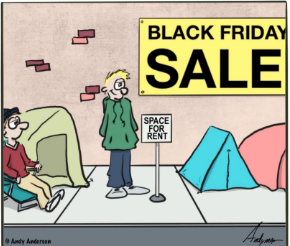
When I think about the day after Thanksgiving, memories of tents outside stores, crowds moving so fast they blur together and televised arguments between shoppers are what resurface.
That used to be Black Friday: loud, messy, chaotic and honestly, magical.
But now, what has Black Friday become? A name once infamously associated with so much chaos and fun is now reduced to nothing but a computer screen.
Black Friday feels quiet. Too quiet. With everything becoming much more digitalized, it’s easy to understand the comfort associated with being able, with a couple of scrolls and the push of a button, to get the exact deals you want.
Data from Drive Research found that “71% of people will shop online this Black Friday, while 29% will shop in-person.”
This data makes sense, but maybe that is the problem. What used to be the most anticipated event has turned into another tab on your webpage. There is no story behind clicking “add to cart,” no memories associated with refreshing a screen, waiting for a deal to drop.
The rush of Black Friday is dearly missed because convenience has replaced tradition. Comfort has replaced fun.
A generation of kids have grown up without the experience of being in Walmart late Friday night, staring at the ravaged shelves or helping carry a discount TV to the car.
The crowd was annoying, yes. The lines were ridiculous, very, but the joy was ever present, influencing a whole generation with shared memories. Those small moments create a feeling that lasts long after the sales end.
These experiences bonded people together who would never have met otherwise. Maybe as a generation, we have become lazy, not willing to trade our pajamas for a chance to explore the chaos in stores.
But not all the blame falls on us. It also lies in the way the deals are increasingly worse every year, which makes the motivation to go to stores non-existent.
Due to economic pressures, businesses have to either risk not making a profit or selling customers a good deal. Too often, the “sale” prices are just regular, disguised with a big red sticker marked “90% off.” This makes in-store shopping hardly ever feel worth the trouble.
Online stores, meanwhile, have so many more opportunities to make profits by having access to buyers across the world. As the Payment Association noted, “Unlike a physical store, an online business isn’t restricted by geographical location. Merchants can reach customers worldwide at any time, significantly expanding the potential of sales and customer accessibility.”
After COVID, most stores do not have the luxury of operating like online stores. Many ended the 24-hour openings and stopped creating the atmosphere that made Black Friday special in the first place. When tradition dies on one end and convenience falls on the other, what chance does Black Friday have?
And even though this holiday is feeding into consumerism and is another method to convince more people to feed the economy. Ask yourself what holiday isn’t?
The world revolves around consumerism and I think that’s how we started to show our affection for one another. Valentines day, Christmas, Thanksgiving, all holidays that revolve around affection and…. consumerism.
It seems everything is working against the comeback of Black Friday, but in a world full of depressing chaos, what’s the issue with some light-hearted chaos, too?
Maybe these are the realities of growing up in a digital age that we have to accept.
Or maybe the natural evolution of consumer culture has doomed us all.
According to a 2025 industry report written by Remco Livain, “e-commerce now accounts for about 16.2% of total retail sales in the U.S., reflecting a steady long-term shift toward online retail and away from brick-and-mortar stores.”
Our need for urgency and immediacy has stolen the enjoyment of the simplicity of pushing a cart down the aisle. It feels like something has been lost, something that made the holidays feel more alive.
Black Friday wasn’t only about shopping; it was a memory and an event. But now it’s a website. Maybe that’s easier, maybe it’s more practical, but it’s definitely the holiday magic.
And personally? I think we deserve the magic back.