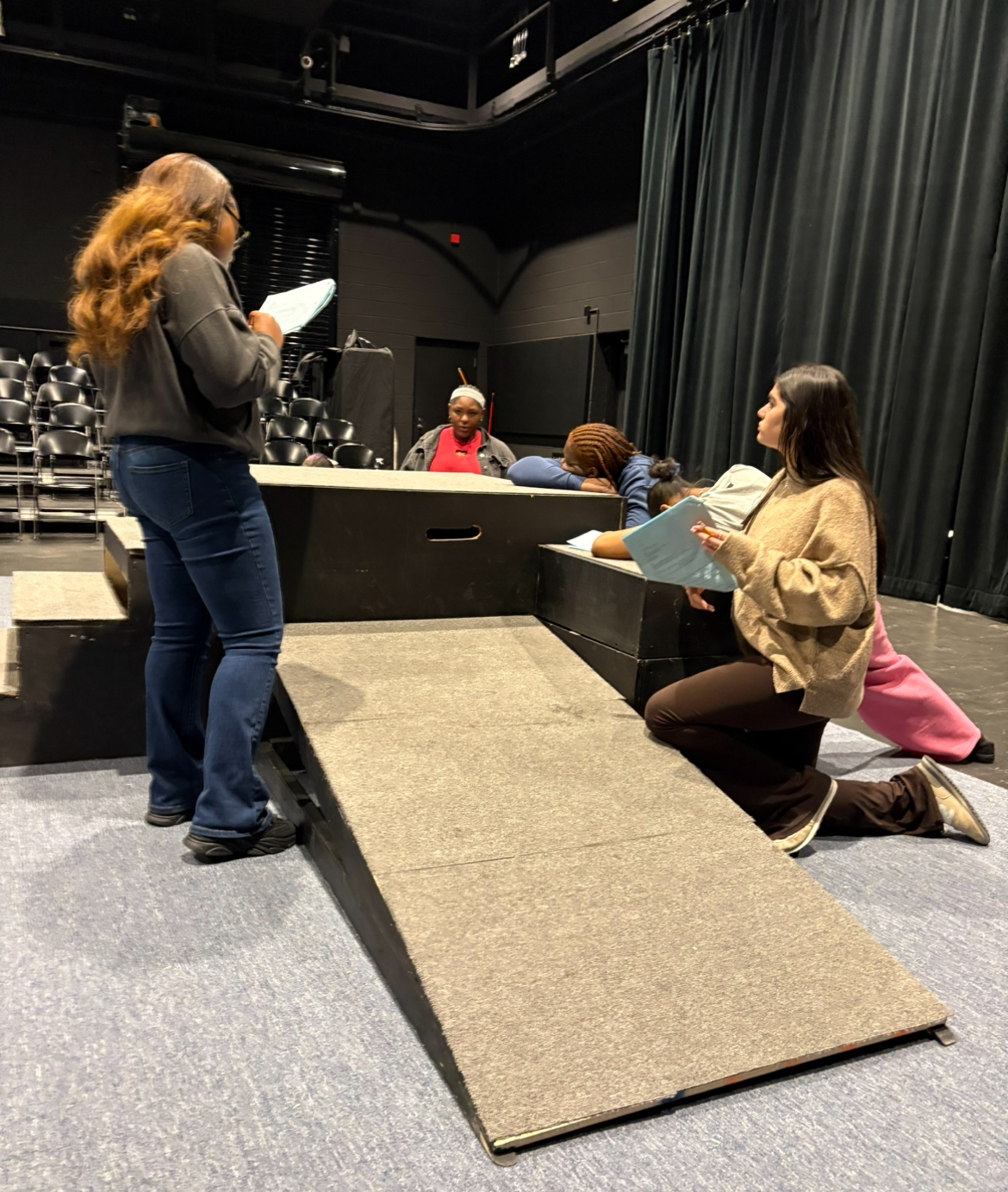
H-F’s Group Interpretation season is officially up and running, with the team practicing about four hours after school each day in preparation for the sectional tournament on March 21.
Group Interpretation (GI) is a competitive, stylized form of theater presented through a 30-minute performance of a piece of choice. The group isn’t allowed to use any props and must convey the story only with facial expressions, body movements and voice.
English teachers and GI coaches Kanoa Mulling and Kona Burks and Speech and GI coach Aundria LaNier start the season completely backwards from your average H-F play or musical. The coaches first find a cast and from there, decide on a piece.
“We give a bunch of different monologues from possible pieces, and we want to see what they give us. Do they give us comedy? Do they give us drama? Do they give us serious and authoritative or whimsical?” Mulling explained. “Then when we have callbacks, we see how well they can work together and how physical they can be.”
With no props or set, the group’s expressions and ability to communicate a piece physically are crucial to GI’s success. The audience and judges need to be able to see all the emotion on their faces at all times, which leads to something called offstage focus, a style where actors face outwards and not at each other, even while having conversations.
“What we’ve learned over the last few years is that it’s really important that everybody on stage is fully committed to the mood of each moment,” Mulling said. “If there’s anyone whose body is inactivated, even if they’re just looking off in the wrong direction, those are the things that start to distract and detract from the overall effect and the judges notice that.”
The coaches find it makes a significant difference when the ensemble is connected to the piece they’re performing. The cast this year is majority female, which sparked the idea to use an excerpt from the book “Rage Becomes Her: The Power of Women’s Anger” by Soraya Chembley.
“In one of our first rehearsals, we made a circle and I expected this to be like a 10-minute exercise. We made a free space for people to say what makes them absolutely furious, and it turned into an hour and a half of ranting,” Mulling shared. “It became increasingly clear that the energy behind this book really matched some of the things in the veins of our current ensemble.”
The book is non-fiction, which makes it harder to build a compelling story off of. Due to this, the group is taking creative liberty to combine excerpts from the book with the story of Jordan Peele’s horror film “Us.”
“It sounds silly but [the pieces] work really well together,” Senior Shamari Brown said. “I connect with it because women are often misunderstood and that is sometimes so frustrating.”
Mulling finds the group’s creativity and flexibility make for a unique process.
“I’m super proud of this. I think a lot of teams tend to lock into a formula and repeat it every year,” Mulling said. “We just totally don’t do that at all. Maybe there’s some inspiration from past performances, but it’s a completely different story and I think that process is exciting.”
Senior Charlotte Symowicz is participating in her third GI season as the group’s musician, but that isn’t how she started. “Two years ago, our musician dropped out and [Symowicz], as the assistant director, just stepped in,” Mulling explained.
“I had to learn all the music in like a week before we performed for H-F classes,” Symowicz said. “But I did it and we went to State that year.”
Symowicz finds the community aspect of GI is what makes her come back. “You build a lot of connections because you’re forced to be around each other for hours and hours every single day for a month,” Symowicz explained. “It’s such a team effort. It’s like, ‘dang, all these people are depending on me.’ You have to put it all out there, or it reflects badly on everyone, not just you.”