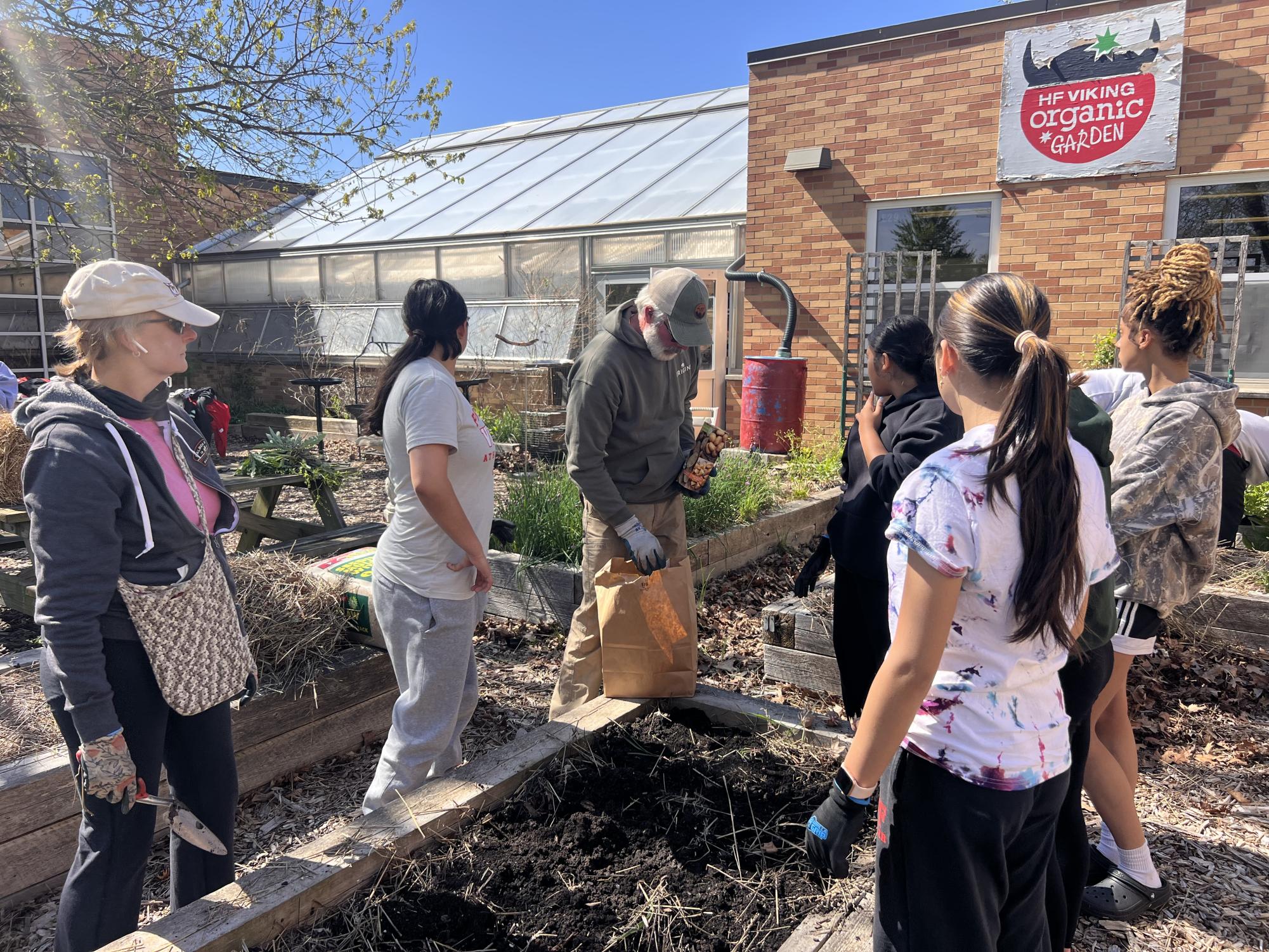
H-F’s garden has served the community for over a decade, growing fresh produce and providing hands-on learning opportunities. But despite its strong roots in the community, the garden has struggled in recent years to maintain student involvement and consistent use.
With the decision to place the community garden at H-F, the village of Flossmoor hoped to encourage local high school students to get involved in growing plants and foster a love of the environment.
“The H-F campus is very large and should have endless opportunities for students to engage with it,” Vice Chair of the Green Commission Eric Turnquest said. “I want students to get outside and dream about what they want to learn about. I want students to know what a fresh potato from the ground tastes like.”
A garden is only the start, as Turnquest hopes students become inspired and reach for the leafy stars. “It could be a Monarch butterfly weigh station, food forest, prairie or getting botanical garden status for the campus,” Turnquest said.
However, before advancing towards these larger goals, the commission must first strengthen its original mission: the community garden.
The garden was first established thanks to a donation from an H-F alumnus. Community organizers, such as Green Commission Chair Tristan Shaw, local farmers Stephanie Wright and Maggie Bachus and Community Engagement Manager Joshua Snedden, “aimed to support healthy eating, organic gardening and environmentally friendly practices,” H-F alumni coordinator Victoria Koblick said.
In its early years, the garden “successfully planned, planted and maintained a variety of organic foods, serving as a living laboratory for education, community connection and environmental stewardship,” Koblick explained.
Beyond food production, a community garden is also a valuable learning experience for students. AP Environmental Science teacher Stephanie Gioiosa emphasized the lessons gardening provides.
“You realize it’s not hard to grow different crops, to eat fresh and to eat locally,” she said. ”It brings connection into the community as a healthy activity everyone can participate in.”
Collaboration has always been the key to the garden’s continuing success, relying on administration, student volunteers and community leaders.
Teamwork formed the foundation of the garden and remains the pivotal ingredient in its lasting growth.
“The H-F Organic Garden is a true team effort, combining student leadership, community involvement and alumni support,” Koblick stated. “It provides hands-on learning, promotes healthy eating and strengthen connections between H-F students and the broader Flossmoor community.”
Despite its strong start, the ties connecting H-F students to the garden are thinning. Which leaves us with the question of, what happened? And how can we bridge the disconnect?
Bachus has described the challenge as getting staff and classes to regularly use the space, as school demands have limited involvement.
While Carrie Malfeo, another early supporter of the garden, simply put it as, “getting staff and student club support.”
Increasing student participation is crucial, but so is elevating students’ interest in environmental issues to help sustain the garden long-term.
The new curriculum at H-F aims to address these challenges by incorporating the garden into new academic pathways and internship opportunities.
Assistant Superintendent of Curriculum and Instruction Lisa Dallacqua elaborated on how the garden could be used in these new programs.
“Right now, we have a plant and animal systems pathway, and we are thinking about utilizing that space for an internship experience for the kids,” Dallacqua explained. “We are also bringing a new course to the board for approval. It’s a class called Introduction to Sustainable Food Systems. We are hoping that with this new course, we can put it into a pathway, such as an environmental garden, and utilize the green space for the plants and animal systems.”
As for the students’ interest in such pathways, she expressed how high it is. “We have a lot of students registering [who] are interested in the plant and [animal] systems.”
When asked whether the garden could serve as a living classroom, Dallacqua did not hesitate.
“Yes, absolutely it should,” she said. “The requirement by the state is authenticity, and what’s more authentic than an actual garden?”
The H-F garden is more than a place where produce grows; it is where past and present generations connect.
As Koblick noted, it “not only preserves H-F traditions and values but also fosters a shared sense of pride, responsibility and community across generations of Vikings.”